Software Development Lifecycle
Our software development service turns good ideas into great results. Results that protect our client's intellectual property (IP), turn their ideas into reality and create value through automation. Leverage your IP and our smarts to get more.
END TO END SOFTWARE DEVELOPMENT
CLIENT FOCUSED PROCESSES THAT KEEP YOU IN THE KNOW
Cras ultricies ligula sed magna dictum porta. Cras ultricies ligula sed magna dictum porta. Curabitur aliquet quam id dui posuere blandit. Donec sollicitudin molestie malesuada. Mauris blandit aliquet elit, eget tincidunt nibh pulvinar a. Proin eget tortor risus. Proin eget tortor risus. Nulla porttitor accumsan tincidunt.
Vivamus suscipit tortor eget felis porttitor volutpat. Vivamus suscipit tortor eget felis porttitor volutpat. Vivamus suscipit tortor eget felis porttitor volutpat. Curabitur non nulla sit amet nisl tempus convallis quis ac lectus. Cras ultricies ligula sed magna dictum porta. Donec sollicitudin molestie malesuada. Nulla porttitor accumsan tincidunt. Proin eget tortor risus. Proin eget tortor risus.

Innovate
Lorem ipsum dolor sit amet, consectetur adipscing elit. Nulla auctor

Invent
Lorem ipsum dolor sit amet, consectetur adipscing elit. Nulla auctor

Improve
Lorem ipsum dolor sit amet, consectetur adipscing elit. Nulla auctor
Planning and Requirement Analysis
Requirement analysis is the most important and fundamental stage in SDLC. It is performed by the senior members of the team with inputs from the customer, the sales department, market surveys and domain experts in the industry. This information is then used to plan the basic project approach and to conduct product feasibility study in the economical, operational and technical areas. Planning for the quality assurance requirements and identification of the risks associated with the project is also done in the planning stage. The outcome of the technical feasibility study is to define the various technical approaches that can be followed to implement the project successfully with minimum risks.
Estimated time: ongoing
Defining Requirements
Once the requirement analysis is done the next step is to clearly define and document the product requirements and get them approved from the customer or the market analysts. This is done through an SRS (Software Requirement Specification) document which consists of all the product requirements to be designed and developed during the project life cycle.
Once the requirement analysis is done the next step is to clearly define and document the product requirements and get them approved from the customer or the market analysts. This is done through an SRS (Software Requirement Specification) document which consists of all the product requirements to be designed and developed during the project life cycle.Estimated time: ongoing
Designing the Product Architecture
SRS is the reference for product architects to come out with the best architecture for the product to be developed. Based on the requirements specified in SRS, usually more than one design approach for the product architecture is proposed and documented in a DDS - Design Document Specification. This DDS is reviewed by all the important stakeholders and based on various parameters as risk assessment, product robustness, design modularity, budget and time constraints, the best design approach is selected for the product. A design approach clearly defines all the architectural modules of the product along with its communication and data flow representation with the external and third party modules (if any). The internal design of all the modules of the proposed architecture should be clearly defined with the minutest of the details in DDS.
Estimated time: ongoing
Building or Developing the Product
In this stage of SDLC the actual development starts and the product is built. The programming code is generated as per DDS during this stage. If the design is performed in a detailed and organised manner, code generation can be accomplished without much hassle. Developers must follow the coding guidelines defined by their organisation and programming tools like compilers, interpreters, debuggers, etc. are used to generate the code. Different high level programming languages such as C, C++, Pascal, Java and PHP are used for coding. The programming language is chosen with respect to the type of software being developed.
Estimated time: ongoing
Testing the Product
This stage is usually a subset of all the stages as in the modern SDLC models, the testing activities are mostly involved in all the stages of SDLC. However, this stage refers to the testing only stage of the product where product defects are reported, tracked, fixed and retested, until the product reaches the quality standards defined in the SRS.
Estimated time: ongoing
Deployment in the Market and Maintenance
Once the product is tested and ready to be deployed it is released formally in the appropriate market. Sometimes product deployment happens in stages as per the business strategy of that organisation. The product may first be released in a limited segment and tested in the real business environment (UAT- User acceptance testing). Then based on the feedback, the product may be released as it is or with suggested enhancements in the targeting market segment. After the product is released in the market, its maintenance is done for the existing customer base.
Estimated time: ongoing
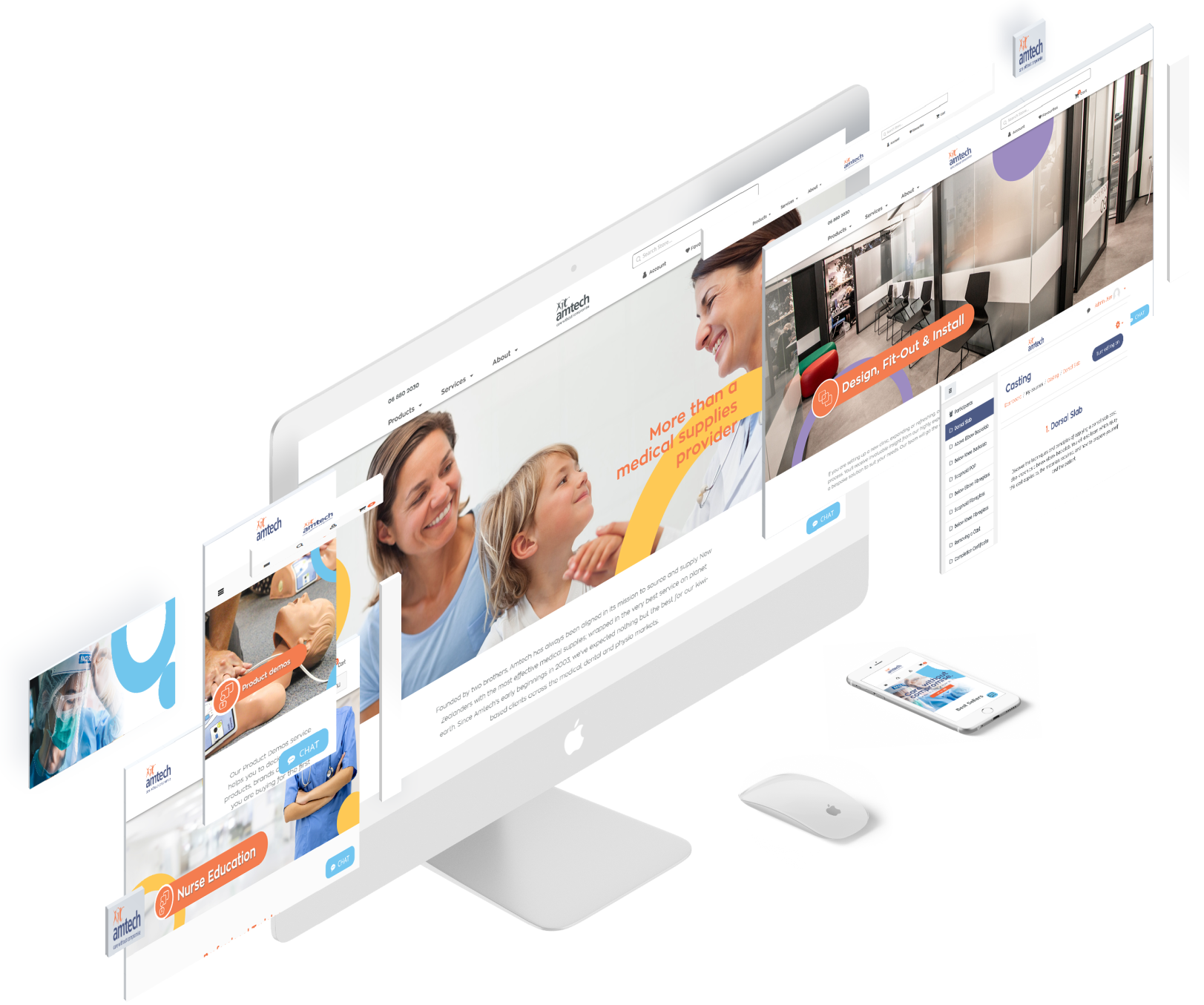
Medical Supplies Provider
Nulla porttitor accumsan tincidunt. Curabitur non nulla sit amet nisl tempus convallis quis ac lectus. Curabitur aliquet quam id dui posuere blandit. Nulla porttitor accumsan tincidunt.
Software tools and applications
Lorem ipsum dolor sit amet, consectetur adipiscing elit. Nulla auctor ante a sapien hendrerit consectetur.
Curabitur tellus lectus, feugiat in gravida a, facilisis a enim.

Project Management
Technology teams are only as successful as their skills are relevant, we invest heavily into our development team to consistently grow with hands-on learning, frequent skills testing & tailored training pathways.
Learn More
Skill Improvement
Communication and clear vision is vital to ensure your expectations and requirements are being met. We allocate a devoted product owner as your key point of contact for meetings, change requests, reviews & reports.
Learn More
Quality Control
All code enters a vigorous automated testing phase checking security, efficiency & styling before it can be released to staging, secure, maintainable & clean code is always being delivered without slowing pipelines.
Learn MoreGeneral FAQ
Lorem ipsum dolor sit amet, consectetur adipisicing elit. Ducimus iste dignissimos quidem quod, ex omnis alias enim quae.
Lorem ipsum dolor sit amet, consectetur adipisicing elit. Voluptates illum aspernatur odio similique voluptatibus itaque magni dicta quasi nesciunt. Possimus animi in, voluptatem facere sint aut quibusdam expedita. Voluptates, laudantium.Lorem ipsum dolor sit amet, consectetur adipisicing elit. Sunt aliquam cumque praesentium iusto delectus rem officia quas quos tempore quaerat laudantium incidunt minus, quae veniam itaque expedita voluptatum perspiciatis adipisci!
Lorem ipsum dolor sit amet, consectetur adipisicing elit. Voluptates illum aspernatur odio similique voluptatibus itaque magni dicta quasi nesciunt. Possimus animi in, voluptatem facere sint aut quibusdam expedita. Voluptates, laudantium.Lorem ipsum dolor sit amet, consectetur adipisicing elit. Sunt aliquam cumque praesentium iusto delectus rem officia quas quos tempore quaerat laudantium incidunt minus, quae veniam itaque expedita voluptatum perspiciatis adipisci!
Lorem ipsum dolor sit amet, consectetur adipisicing elit. Voluptates illum aspernatur odio similique voluptatibus itaque magni dicta quasi nesciunt. Possimus animi in, voluptatem facere sint aut quibusdam expedita. Voluptates, laudantium.Lorem ipsum dolor sit amet, consectetur adipisicing elit. Sunt aliquam cumque praesentium iusto delectus rem officia quas quos tempore quaerat laudantium incidunt minus, quae veniam itaque expedita voluptatum perspiciatis adipisci!